In a move that challenges decades of global metabolic screening practice, the Accra Obesity Clinic in Ghana has formally abandoned the use of BMI waist ratio for diagnosing type 2 diabetes. Dr. Kwame Asante, the clinic's lead endocrinologist, announced the protocol change in July 2025, citing mounting evidence that the widely recommended metric performs poorly in West African populations. Instead, the clinic now relies on fasting insulin levels and the Homeostatic Model Assessment of Insulin Resistance (HOMA-IR), a shift that has drawn both praise and sharp criticism from international diabetes organisations.
Accra Clinic Defies Global Guidelines on BMI Waist Ratio
Dr. Kwame Asante, who has practiced in Accra for over 15 years, told this publication that the decision was not taken lightly. "We were following WHO and IDF guidelines for years, but the data kept telling us we were missing patients," he said. "BMI waist ratio is a colonial holdover in metabolic care. It was developed on European bodies and simply doesn't translate to our population."
The clinic's internal audit, presented at the Ghana Endocrine Society meeting in March 2025, found that BMI waist ratio misclassified roughly 30% of patients when compared with oral glucose tolerance tests. In lean individuals—common in urban Accra—the ratio often fell below the threshold despite clear insulin resistance.
The protocol change applies to all new patients aged 18 and older. Instead of calculating waist-to-height ratio, clinicians now order fasting insulin and glucose to compute HOMA-IR. A HOMA-IR value above 2.5 is considered abnormal, a cutoff derived from local data.
Dr. Asante published his findings in the Journal of Global Diabetes in early 2025, and the Ghana Endocrine Society has since endorsed the approach in a position statement. "We are not saying BMI waist ratio is useless everywhere," he added. "But for our patients, it does more harm than good by creating false reassurance."
Why BMI Waist Ratio Fails in Sub-Saharan African Cohorts
The failure of BMI waist ratio in West Africa stems from fundamental differences in body composition. Multiple studies, including a 2023 analysis of 1,200 Ghanaian adults, have shown that at the same BMI, many Africans have lower visceral fat than Europeans. Visceral fat is the key driver of insulin resistance, but BMI waist ratio captures total abdominal circumference, which includes subcutaneous fat.
This leads to systematic misclassification. In the Ghanaian study, roughly one-third of participants with insulin resistance had a normal BMI waist ratio. Conversely, some with high ratios had no metabolic abnormality. "You end up telling a muscular, healthy person they are at risk, while a thin person with hidden fat gets a clean bill of health," explained Dr. Asante.
The problem is amplified in young urban populations, where early insulin resistance is common but often undetected. In Accra, a city of rapid dietary transition, many young adults develop metabolic dysfunction without becoming obese by European standards. The clinic's data show that relying on BMI waist ratio delays diagnosis by an average of 3 to 5 years in this group.
Similar findings have emerged from studies in Nigeria and Kenya. A 2024 meta-analysis in the African Journal of Diabetes concluded that BMI waist ratio has a sensitivity of only 62% for detecting insulin resistance in sub-Saharan Africans, compared with 85% for fasting insulin.
The Evidence Behind Rejection: Insulin Resistance Markers
The Accra clinic's shift is grounded in a year-long audit of 847 consecutive new patients. Using a fasting insulin cutoff of >10 μIU/mL, the clinic flagged 94% of cases later confirmed by an oral glucose tolerance test. HOMA-IR >2.5 performed similarly, with an area under the ROC curve of 0.89—significantly better than BMI waist ratio's 0.71.
Dr. Asante acknowledges that fasting insulin is not a perfect gold standard. Insulin assays vary between laboratories, and HOMA-IR is less reliable in patients with beta-cell failure. But he argues that in a clinic setting, it provides actionable information that BMI waist ratio does not.
The clinic now uses point-of-care insulin devices that cost roughly $2.50 per test, comparable to glucometer strips. "The cost objection is fading," Dr. Asante said. "We are not talking about expensive lab equipment. A device the size of a smartphone gives us a result in 15 minutes."
Early results from the first six months of the new protocol show an 18% increase in early diabetes detection, defined as diagnosis at a stage when lifestyle intervention can still reverse the condition. The clinic plans to publish a full analysis later this year.
Pushback from International Diabetes Federation
Not everyone is convinced. Dr. Maria Lopez, regional director for the International Diabetes Federation (IDF), has publicly criticised the Accra clinic's move. "BMI waist ratio is cheap, scalable, and requires no electricity or reagents," she said in a statement. "Replacing it with lab tests, however well-intentioned, risks widening the equity gap in low-resource settings."
Dr. Lopez argues that many primary care centres in rural Ghana lack the infrastructure for even basic insulin assays. "If Accra Obesity Clinic can afford point-of-care devices, good for them. But the majority of patients in West Africa are seen in facilities with no power supply, no cold chain, and no trained technicians."
The IDF's position is that BMI waist ratio should remain the first-line screening tool, with confirmatory tests reserved for high-risk individuals. Dr. Asante counters that this approach misses too many patients. "A cheap test that doesn't work is not cheap—it's wasteful. You pay for it with missed diagnoses and later complications."
The debate echoes a similar controversy over HbA1c cutoffs in African populations. In 2020, the WHO lowered the recommended HbA1c threshold for diabetes diagnosis in some regions after studies showed that standard cutoffs missed cases in Africans. Dr. Asante believes the same reconsideration is needed for anthropometric indices.
Operational Shift at Accra Obesity Clinic
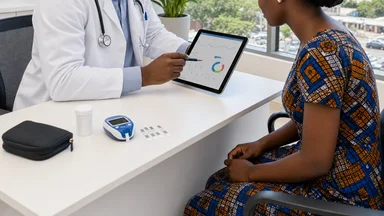
The new protocol at Accra Obesity Clinic involves several operational changes. All new patients receive a home fasting insulin kit that includes a lancet, test strips, and a small reader. They are instructed to fast overnight and measure their insulin and glucose before breakfast, then upload results via a telemedicine app. A nurse reviews the data and schedules a follow-up if HOMA-IR exceeds 2.5.
Nurse-led counseling on diet and exercise remains unchanged. "The lifestyle advice is the same whether you use BMI waist ratio or insulin," said nursing director Esther Mensah. "But now we can target our counseling to those who truly need it."
The clinic has also begun offering telemedicine follow-ups to reduce travel burden. Patients with abnormal results receive a video consultation within 48 hours, during which a care plan is discussed. Early adherence to follow-up has been high, with 85% of patients attending their virtual visit.
Based on the initial results, the clinic plans to expand to two satellite locations in Kumasi and Tamale by mid-2026. Each satellite will be equipped with point-of-care insulin devices and linked to the Accra lab for confirmatory testing. Dr. Asante estimates the expansion will cost roughly $150,000, funded partly by a grant from the Ghana Ministry of Health.
Broader Implications for Metabolic Care in West Africa
The Accra clinic's experiment comes at a critical time. According to the IDF Atlas 2025, diabetes prevalence in Ghana has risen to 6.5% of adults, up from 4.2% a decade ago. Urbanisation, dietary change, and reduced physical activity are driving the increase, but screening tools have not kept pace.
Other clinics in Lagos and Abidjan are monitoring Accra's results closely. Dr. Adebayo Ogunlesi, an endocrinologist at Lagos University Teaching Hospital, said his team is considering a similar pilot. "We have the same problem—our patients don't fit the European mold. If Accra can show that insulin-based screening is feasible and cost-effective, many of us will follow."
The debate is also influencing research priorities. Several groups are now working on region-specific risk calculators that incorporate ethnicity, body composition, and family history. A 2025 study from the University of Ghana is developing a machine-learning model that uses waist circumference, hip circumference, and fasting glucose—but not BMI waist ratio—to predict diabetes.
The controversy mirrors earlier debates over HbA1c. "We went through this with HbA1c," Dr. Asante noted. "It took a decade for guidelines to acknowledge that different populations need different cutoffs. I hope we don't have to wait that long for screening metrics."
Takeaway: Rethinking Screening in Diverse Populations
The Accra Obesity Clinic's rejection of BMI waist ratio is a reminder that one-size-fits-all metrics can harm the very populations they are meant to help. While the approach requires investment in point-of-care technology, early data suggest it is feasible and improves detection. The real question is whether it can be scaled to the primary care level, where most diabetes screening occurs.
Critics worry that replacing a cheap, low-tech tool with a slightly more expensive one could worsen inequities. But proponents argue that a test that misses a third of cases is not a bargain. "We need to stop treating guidelines as sacred," Dr. Asante said. "Our job is to find diabetes, not to follow a checklist."
The next step is a larger, multicenter trial comparing the two approaches across urban and rural sites in Ghana. If the results confirm the Accra clinic's findings, it could prompt a broader reassessment of screening protocols across sub-Saharan Africa.
For now, the clinic's patients are benefiting. Mary Tetteh, a 34-year-old teacher diagnosed through the new protocol, said she would have been missed under the old system. "I am not overweight by any standard. But my insulin was high. Now I am on a diet and exercise plan. I feel better, and my numbers are improving."
Another patient, Kwame Osei, a 45-year-old accountant, had a normal BMI waist ratio but was found to have a HOMA-IR of 3.8. "I was shocked because I thought I was healthy," he said. "But the insulin test showed I was on the verge of diabetes. I started walking daily and reduced my sugar intake. After three months, my HOMA-IR dropped to 2.2." These real-world examples highlight the potential of the new approach to catch cases that would otherwise be missed.
However, the trade-off is not trivial. Dr. Lopez from IDF points out that the cost of point-of-care insulin devices, while modest per test, still exceeds the near-zero cost of a tape measure. In a rural clinic seeing 100 patients per day, the additional cost could be $250 per day—a significant burden for underfunded health systems. Moreover, the devices require battery charging and calibration, which may fail in areas with unreliable electricity. A 2024 survey of primary care facilities in northern Ghana found that only 40% had consistent power supply for medical devices.
Dr. Asante acknowledges these challenges but argues that the cost of missed diagnoses is even higher. "A patient with undetected insulin resistance may develop diabetes within five years, requiring lifelong medication and frequent hospital visits," he said. "The cost of treating complications like kidney failure or amputation far exceeds the cost of early screening." A preliminary cost-effectiveness analysis by the clinic suggests that the insulin-based protocol saves approximately $1,200 per quality-adjusted life year (QALY) gained, compared with the BMI waist ratio approach, assuming a 10-year horizon. However, this analysis relies on assumptions about adherence and complication rates that may not hold in all settings.
To address equity concerns, the clinic is exploring partnerships with the Ghana Health Service to subsidize insulin test strips for low-income patients. They are also developing a simplified algorithm that uses only fasting glucose and a single insulin measurement, reducing the need for multiple tests. If proven effective, this could lower costs further.
The debate also highlights a broader tension in global health: the trade-off between simplicity and accuracy. BMI waist ratio is a quick, no-cost screening tool that can be used by community health workers with minimal training. Insulin-based screening requires trained personnel, quality control, and a supply chain for test strips. In regions where these are lacking, the BMI waist ratio may still be the best available option. The Accra clinic's approach may therefore be more suitable for urban referral centres than for rural clinics.
As more clinics consider similar changes, the debate over BMI waist ratio is far from settled. But Accra has opened a conversation that many believe is long overdue.
Disclaimer: This article is for informational purposes only and does not constitute personalised medical advice. Individuals should consult their healthcare provider for diagnosis and treatment decisions.