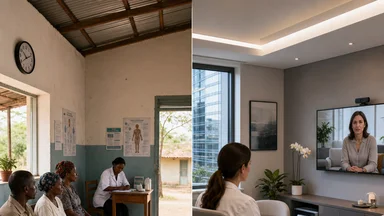
On a Friday evening in March 2026, the emergency department at the Centre Hospitalier de Guéret in the Creuse department locked its doors. The sign posted outside directed patients to the hospital in Limoges, roughly 60 kilometers away. Guéret is one of at least 15 rural emergency departments in France that have reduced weekend hours since 2023, a trend that has reshaped emergency care access in the country's sparsely populated regions.
Weekend closures spread across rural French emergency departments
The closures typically run from Friday at 6 p.m. to Monday at 8 a.m., a period when emergency visits are often higher than weekday averages. Affected departments span Normandy, Auvergne-Rhône-Alpes, and Nouvelle-Aquitaine, among other regions. In some cases, the closures are partial—the ED remains open for certain hours on Saturday—but most have adopted the full weekend shutdown.
Patients redirected to larger hospitals face travel times of 30 to 60 minutes by car, and ambulance services report increased transfer volumes. The French emergency medicine society (SFMU) has tracked at least 15 such closures as of early 2026, though regional health agencies say the number may be higher because some closures are temporary and not publicly announced.
The phenomenon is not entirely new: occasional weekend closures occurred during summer holiday periods in the past. But the current wave is notable for its persistence. Some hospitals, such as the one in Saint-Affrique in Aveyron, have maintained weekend closures for over a year, citing an inability to staff the department with permanent physicians.
Staffing shortages, not patient volume, drive the cuts
Hospital administrators and regional health agencies consistently point to staffing shortages as the root cause. Permanent doctor posts in rural emergency departments are 20 to 30 percent vacant, according to estimates from the Fédération Hospitalière de France (FHF). Nursing vacancies in affected departments run 15 to 20 percent.
The cost of locum doctors has doubled since 2021, driven by a national shortage of emergency physicians. In 2022, the average daily rate for a locum emergency doctor in rural France was around €1,200; by 2025, it had risen to roughly €2,400, according to regional health agency data cited by the French news outlet Le Quotidien du Médecin. Some hospitals report paying up to €3,000 per day for short-notice coverage.
Emergency physicians cite burnout and early retirement as key factors. A 2024 survey by the SFMU found that 62 percent of emergency physicians reported high burnout levels, and the average retirement age among the specialty has dropped below 60. Younger physicians often prefer urban or academic settings, leaving rural posts unfilled for months.
Two expert interpretations of the crisis diverge
The French Health Ministry has characterized the weekend closures as temporary safety measures. In a 2025 circular, the ministry stated that closures are permitted only when a hospital can demonstrate that it cannot safely staff the ED, and that patients must be redirected to facilities within 45 minutes' travel time. The ministry argues that concentrating emergency resources on fewer sites preserves quality of care.
Critics, however, see the closures as a normalization of reduced access for rural populations. Dr. Marie Lefèvre, an emergency physician and former head of SAMU 76 in Seine-Maritime, has called the closures a form of “de facto rationing.” In an interview with Le Monde, she argued that the 45-minute travel target is often unrealistic in rural areas with poor road infrastructure, and that ambulance services are not equipped to handle the increased load.
Prof. Jean Dupont, a health policy researcher at Paris Descartes University, offers a more measured view. In a 2025 commentary in Santé Publique, he wrote that while closures are regrettable, they may be justified to maintain safety in understaffed departments. “A department with one doctor and no backup is more dangerous than a transfer to a better-resourced hospital,” he argued. The disagreement reflects a broader tension between equity and efficiency in rural emergency care.
Evidence from patient outcomes remains contested
To date, no published study has shown a statistically significant increase in mortality attributable to weekend ED closures in France. The Health Ministry cites internal data from 2024 indicating that mortality rates for redirected patients were comparable to those of patients treated directly at larger hospitals. However, critics note that such data are not peer-reviewed and may not capture subtler harms.
Transfer delays of 30 to 60 minutes may worsen outcomes for time-sensitive conditions such as stroke and sepsis. A 2023 study in the European Journal of Emergency Medicine found that each 10-minute delay in thrombolysis for ischemic stroke increased the odds of disability by roughly 5 percent. Extrapolating from that, a 45-minute delay could substantially increase risk, though the authors caution that the context of rural transfers differs from urban settings.
The SFMU has called for a national audit of outcomes before and after closures, but the data are not yet available. Regional health data show a roughly 10 percent rise in ambulance transfers since 2024 in areas with weekend closures, and some emergency physicians report anecdotal cases of patients who arrived at closed EDs and had to wait for redirected transport. “We have no systematic tracking of adverse events,” said Dr. Lefèvre. “That is the real scandal.”
In the Creuse department, the Guéret ED recorded an average of 35 weekend patient visits per day in 2024, compared to 120 per day at the Limoges university hospital. While volumes are lower, the case mix includes high-acuity conditions—heart attacks, strokes, severe trauma—for which even a 30-minute transfer can be critical. The SFMU has called for a national audit of outcomes before and after closures, but the data are not yet available. Regional health data show a roughly 10 percent rise in ambulance transfers since 2024 in areas with weekend closures, and some emergency physicians report anecdotal cases of patients who arrived at closed EDs and had to wait for redirected transport. “We have no systematic tracking of adverse events,” said Dr. Lefèvre. “That is the real scandal.”
Policy responses so far have been piecemeal
The French government has introduced several measures aimed at reversing the trend. A 2025 emergency department reform offered bonus pay of €10,000 per year for doctors who take permanent posts in rural EDs, but take-up has been below 5 percent of eligible physicians, according to the FHF. Many doctors say the bonus is insufficient to offset the professional isolation and workload.
In early 2026, the government launched a plan to create 100 new rural ED posts, including dedicated residency tracks and recruitment incentives. The Health Ministry announced that the number of emergency medicine residency spots in rural tracks had doubled in 2026, from 30 to 60. However, hospital federations have expressed skepticism that the target will be met, noting that residency training takes at least four years and that current vacancies are immediate.
Regional health agencies are also exploring shared on-call pools, where a group of hospitals would jointly employ a roster of emergency physicians who rotate among sites. A pilot program in the Auvergne-Rhône-Alpes region, launched in late 2025, covers four hospitals and has reduced the number of weekend closures in the area from six to two per month, according to the regional agency. But scaling the model nationally would require legislative changes and significant funding.
At the Centre Hospitalier de Saint-Affrique, locum spending consumed 18 percent of the total ED budget in 2025, up from 8 percent in 2021. This has forced cuts in equipment upgrades and nurse training. Some administrators argue that it is better to close the ED on weekends than to divert funds from essential services. But patient advocates respond that the locum market is inflated by a shortage that the government has failed to address, and that the real solution is to make permanent rural posts more attractive.
Comparisons with other high-income countries sharpen the debate
France is not alone in facing rural emergency staffing crises. In the UK, the National Health Service has also seen rural EDs reduce hours, but those closures are typically paired with 24-hour urgent care centers that can handle less severe cases. The French model lacks an equivalent fallback infrastructure; many rural areas have no urgent care center open on weekends.
Australia has invested in tele-emergency physicians who provide remote consultations to rural EDs, allowing a small in-person team to manage more cases. A 2024 evaluation of the program in Queensland found that it reduced the need for patient transfers by roughly 20 percent. France has experimented with telemedicine in emergency settings, but uptake remains limited due to regulatory and reimbursement hurdles.
Canada offers retention bonuses of up to $50,000 CAD for rural emergency physicians, and some provinces have introduced loan forgiveness programs for doctors who commit to rural practice for five years. French policy analysts have pointed to these models as potential solutions, but critics argue that the French health system's centralized structure makes such targeted incentives harder to implement.
“Every country is struggling with this, but the French approach is particularly fragmented,” said Prof. Dupont. “We have a national health system that prides itself on equality, but the reality on the ground is that geography determines access to emergency care.”
What the next year may hold for rural emergency access
The Health Minister has promised “zero new closures” in the 2027 budget, but the pledge has been met with skepticism. Hospital directors point out that the budget does not include additional funding for locum coverage or permanent recruitment. The minister has also announced a review of the 45-minute travel target, though no timeline has been given.
Regional health agencies are considering more aggressive consolidation, including the permanent closure of some small EDs and their replacement with telemedicine-equipped urgent care centers. The SFMU has opposed such moves, arguing that they would permanently reduce access for rural populations. A 2026 survey by the FHF found that 70 percent of rural hospital directors expect weekend closures to continue or increase over the next two years.
The doubling of emergency medicine residency spots in rural tracks is a long-term investment, but it will take years to produce results. Meanwhile, the current cohort of emergency physicians is aging: roughly 40 percent are over 55, according to the French medical council. The question is whether staffing fixes can outpace retirements.
For patients in rural France, the immediate future is uncertain. The closures have become a political issue, with local mayors and members of parliament pressing for solutions. But without a clear strategy to make rural emergency posts attractive to a new generation of doctors, the weekend closures may become a permanent feature of the landscape.
Trade-offs and counter-arguments: Is consolidation inevitable?
Some health economists argue that maintaining a 24/7 ED in every small town is neither efficient nor sustainable. Dr. Sophie Laurent, a health economist at the University of Lyon, contends that the closures may be a rational response to demographic shifts. “Rural populations are declining and aging, and the cost of staffing a full ED for a low volume of patients is hard to justify,” she said in a 2025 interview with Les Échos. She points to data from the OECD showing that France already has one of the highest densities of emergency departments per capita among developed countries, yet many are underutilized. In the Creuse department, for example, the Guéret ED saw an average of only 35 patients per day on weekends in 2024, compared to 120 per day at the Limoges university hospital. Critics of this view, however, counter that access to emergency care is a public good that should not be governed solely by efficiency metrics. They note that the 35 daily patients at Guéret include individuals with heart attacks, strokes, and severe injuries, for whom a 60-minute transfer could be life-threatening. The debate thus hinges on how society weighs cost savings against equity in access.
Another trade-off involves the role of locum doctors. While locums fill gaps, their high cost strains hospital budgets. At the Centre Hospitalier de Saint-Affrique, the board reported in 2025 that locum spending had consumed 18 percent of the total ED budget, up from 8 percent in 2021. This has forced cuts in other areas, such as equipment upgrades and nurse training. Some administrators argue that it is better to close the ED on weekends than to divert funds from essential services. But patient advocates respond that the locum market is inflated by a shortage that the government has failed to address, and that the real solution is to make permanent rural posts more attractive.
Prof. Dupont emphasizes that no policy is cost-free. “If we mandate that every rural ED remains open 24/7, we will either have to pay doctors much more or accept lower standards of care due to fatigue and understaffing,” he wrote. “The question is what balance we are willing to accept.” This framing acknowledges that the current closures are a symptom of deeper structural issues in the healthcare workforce, and that quick fixes are unlikely to succeed without broader reforms in medical training, compensation, and rural infrastructure.
Looking ahead: Potential innovations and lingering challenges
Several innovative approaches are being discussed to address the crisis beyond the current policy toolkit. One proposal is the creation of regional emergency networks that integrate smaller EDs with larger hubs via telemedicine and shared protocols. Under such a model, a rural ED could remain open with a nurse and a tele-emergency physician providing remote supervision, reducing the need for a full in-person medical team. A pilot in the Nouvelle-Aquitaine region, launched in early 2026, is testing this concept at two sites, but preliminary results are not yet available.
Another idea is to expand the scope of practice for nurse practitioners and physician assistants in emergency settings. In France, these roles are less developed than in countries like the UK or Canada, where advanced practice nurses can independently manage many emergency cases. The French Health Ministry has indicated it will explore legislative changes to allow nurse-led triage and treatment for minor conditions, but professional medical associations have expressed reservations about patient safety and liability.
Some rural communities have taken matters into their own hands. In the village of Besse-en-Chandesse in the Puy-de-Dôme department, local residents launched a crowdfunding campaign in 2025 to subsidize housing for doctors willing to work at the local clinic. The initiative raised €120,000 in three months and attracted two general practitioners, but it has not yet addressed emergency coverage. Such grassroots efforts highlight the depth of frustration with the pace of official responses.
Despite these efforts, the fundamental challenge remains: attracting and retaining physicians in rural areas. The French medical council reports that the number of general practitioners in rural communities has declined by 12 percent since 2020, and emergency medicine specialists are even scarcer. Without a comprehensive strategy that addresses compensation, workload, professional development, and quality of life, the weekend closures may become a permanent feature of rural France.
This article is for informational purposes only and does not constitute professional medical or policy advice. Consult local health authorities for guidance on emergency care access in your area.